Assessing a moving company on sustainability performance involves looking at three concrete layers: what the company deploys technically (vehicles, materials, energy), which independent certifications it holds, and how transparent it is about measurable CO2 reduction. For facility managers and project managers planning a corporate relocation and needing to comply with CSRD reporting obligations, this distinction is crucial. The questions below guide you step by step through the assessment process.
Which concrete sustainability criteria are most decisive?
The most decisive sustainability criteria for a corporate relocation are the type of transport (electric or fossil-fueled), the reuse percentage of moving materials, the energy performance of storage facilities, and the presence of a circular approach to office furniture. A moving company that provides concrete answers on all these points takes sustainability seriously.
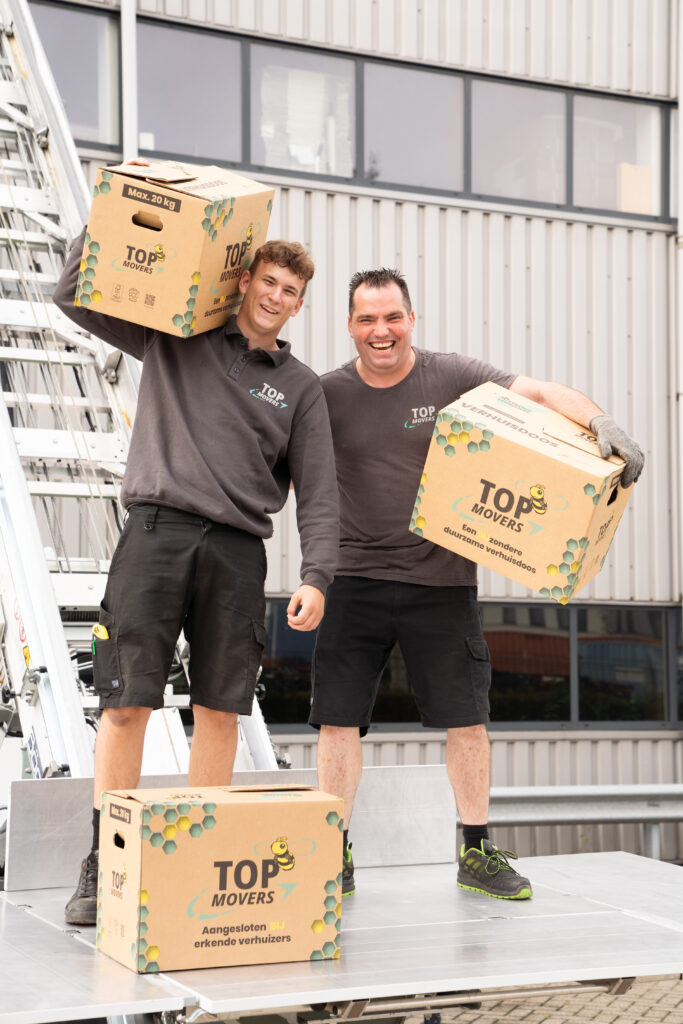
Transport is by far the largest source of emissions during a move. Companies that invest in electric trucks and operate according to the highest European environmental standards show that they look beyond marketing language. But transport alone is not enough: packaging materials also count. Moving boxes made of recyclable ABS plastic with a lifespan of one thousand moves are another example of how material use can be structurally made more sustainable.
Additionally, the question of what happens to office furniture is increasingly relevant. A circular approach, where furniture is inventoried via a furniture passport and reused or revitalized where possible, prevents unnecessary waste and reduces the overall environmental impact of the move. This type of service distinguishes a sustainable partner from a company that merely makes green claims.
Which certifications prove that a moving company truly operates sustainably?
The certifications that demonstrate a moving company genuinely operates sustainably are ISO 14001 (environmental management system), the CO2 Performance Ladder, and VCA (safety, health, and environment). In addition, ISO 9001 (quality management) and the Erkend Projectverhuizer (EPV) quality mark are relevant indicators of professional standards.
ISO 14001 is the most direct benchmark: this certification requires a company to systematically map its environmental impact, formulate objectives, and demonstrably implement improvements. It is not a one-time assessment, but a continuous process that is externally audited. The CO2 Performance Ladder goes a step further by linking environmental ambitions to concrete reduction targets, making it particularly relevant for tenders where sustainability is an award criterion.
VCA certification demonstrates that the company works safely and responsibly in terms of working conditions and the environment, which carries extra weight in complex project relocations in industrial settings such as petrochemicals or the Port of Rotterdam. When requesting a quote, always ask for the current certificates, not just a mention of them.
How do you verify a moving company’s sustainability claims in practice?
You verify sustainability claims in practice by asking for measurable data, not intentions. Ask the moving company for access to its CO2 reporting, the share of electric transport in its fleet, the reuse percentage of moving materials, and the energy performance of its storage facilities. Concrete figures are what distinguish a sustainable partner from a company with a green logo.
A reliable verification starts with the storage facility. A warehouse with an A++++ sustainability classification and solar panels on the roof is tangible proof of investment in sustainable infrastructure, not just a promise. Also ask about the use of environmentally friendly packing materials: are traditional bubble wrap and packing paper being replaced by reusable alternatives?
Also ask about the supply chain behind the move. Does the company work with partners who uphold the same sustainability standards? Networks such as Circular Connect, focused on the reuse of raw materials and the revitalization of office furniture, show that sustainability does not stop at the moving company’s own front door. For business clients who need to submit CSRD reporting, this chain responsibility is not a side issue but a requirement.
What is the difference between CO2 compensation and actual CO2 reduction?
CO2 compensation means that emissions are neutralized elsewhere, for example through reforestation projects, while the company’s own emissions remain unchanged. CO2 reduction means that actual emissions at the source are reduced, through electric transport, more efficient driving behavior, or less material use. For CSRD reporting, reduction carries more weight than compensation.
This distinction is a critical point for facility managers and project managers. An increasing number of organizations are required under CSRD regulations to report not only their own emissions, but also those of their suppliers and service providers. A moving company that claims to be CO2 neutral purely through compensation makes a weaker contribution to your sustainability reporting than a partner that demonstrably emits less.
Therefore, explicitly ask a moving company: what percentage of its CO2 neutrality is based on reduction and how much on compensation? A company that invests in electric trucks, solar panels, and energy-efficient storage facilities can demonstrate reduction. That is the information that matters in a sustainability report and in tenders where environmental criteria factor into the award decision.
What questions should you ask when requesting a quote for an office relocation?
When requesting a quote for an office relocation, ask at minimum these questions in the area of sustainability: what proportion of the transport is emission-free, which certifications are currently valid, how is office furniture assessed for reuse, and can the company provide support with CSRD reporting? These questions quickly filter out who takes sustainability seriously.
In addition to the sustainability questions, there are practical aspects that determine the quality of execution:
- Does the company have experience with comparable projects in your sector, such as petrochemicals or healthcare institutions?
- Does it have its own fleet and storage facilities, or does it work with subcontractors?
- Is a detailed moving checklist drawn up for the entire project?
- Is there support for additional services such as handyman service or cable management after the move?
- Can the company arrange temporary storage of inventory if the new location is not yet ready?
- Does the company offer support with tenders, including the required certification and track record?
A good moving partner not only answers these questions fully, but proactively thinks along with your specific situation. Taking the burden off your hands starts at the quote request stage: if a company already comes with concrete solutions rather than standard answers at that point, that is a reliable signal for what the collaboration will look like during the move.
Veelgestelde vragen
Hoe lang duurt het om een duurzaam verhuisbedrijf te selecteren via een aanbestedingsprocedure?
Een zorgvuldige selectieprocedure voor een duurzaam verhuisbedrijf duurt doorgaans vier tot acht weken, afhankelijk van de complexiteit van het project en het aantal uit te vragen partijen. Reken op minimaal twee weken voor het opstellen van een gedegen programma van eisen met duurzaamheidscriteria, gevolgd door een offerteronde en eventuele presentaties. Door duurzaamheidscriteria zoals ISO 14001, CO2-prestatieladder en het aandeel elektrisch transport vooraf scherp te definiëren, versnelt u het vergelijkingsproces aanzienlijk.
Wat als een verhuisbedrijf nog geen elektrisch wagenpark heeft, maar wel andere duurzame maatregelen neemt — is het dan toch een geschikte partner?
Elektrisch transport is een belangrijk criterium, maar niet het enige. Een verhuisbedrijf zonder volledig elektrisch wagenpark kan alsnog een waardevolle partner zijn als het aantoonbaar investeert in andere reductiemaatregelen, zoals rijgedragoptimalisatie, herbruikbare verpakkingsmaterialen en een circulaire aanpak voor kantoormeubilair. Vraag in dat geval wel naar een concreet transitieplan: heeft het bedrijf vastgelegde doelstellingen voor de elektrificatie van zijn wagenpark, en op welke termijn? Een partner zonder plan is minder geschikt voor organisaties met ambitieuze CSRD-doelstellingen.
Hoe verwerk ik de duurzaamheidsgegevens van een verhuisbedrijf in mijn CSRD-rapportage?
Voor CSRD-rapportage heeft u primaire data nodig: concrete CO2-uitstootcijfers van de verhuizing, uitgesplitst naar Scope 1, 2 en 3 emissies. Vraag het verhuisbedrijf om een verhuisemissierapport na afloop van het project, bij voorkeur opgesteld volgens de GHG Protocol-methodiek. Bedrijven die de CO2-prestatieladder hanteren, zijn doorgaans goed in staat deze data te leveren in een formaat dat direct bruikbaar is voor uw duurzaamheidsverslag of dat van uw externe accountant.
Wat zijn de meest voorkomende fouten die organisaties maken bij het beoordelen van duurzame verhuisbedrijven?
De meest gemaakte fout is afgaan op certificeringsvermeldingen zonder de actuele geldigheid te controleren — certificeringen zoals ISO 14001 moeten periodiek worden herbevestigd en kunnen verlopen. Een tweede veelgemaakte fout is het gelijkstellen van CO2-compensatie aan CO2-reductie, waardoor een bedrijf met uitsluitend offsetprojecten ten onrechte als duurzamer wordt beoordeeld. Tot slot onderschatten veel organisaties het belang van ketenverantwoordelijkheid: ook de duurzaamheidsprestaties van onderaannemers en transportpartners tellen mee in uw Scope 3-emissies.
Kan een duurzame bedrijfsverhuizing ook kostenbesparend zijn, of is het altijd duurder?
Een duurzame bedrijfsverhuizing hoeft niet duurder te zijn en kan op meerdere punten juist kostenbesparend werken. Herbruikbare verhuisboxen elimineren de aanschaf en afvoer van eenmalig karton, een circulaire meubelbeoordeling voorkomt onnodige nieuwkoopkosten, en efficiënte routeplanning met elektrisch transport verlaagt brandstof- en onderhoudskosten. Bovendien kan een verhuisbedrijf met een hoge CO2-prestatieladderscore bij aanbestedingen gunningsvoordeel opleveren, wat indirect de totale projectkosten drukt.
Hoe ga ik om met kantoormeubilair dat niet hergebruikt kan worden — is vernietiging dan de enige optie?
Vernietiging is zelden de enige of beste optie. Meubilair dat niet direct herbruikbaar is, kan via revitalisering — zoals opnieuw bekleden of repareren — een tweede leven krijgen, of worden aangeboden aan sociale ondernemingen en non-profitorganisaties. Netwerken gericht op circulaire grondstoffenstromen koppelen overtollig kantoormeubilair aan partijen die er wel gebruik van kunnen maken. Vraag uw verhuisbedrijf expliciet naar de verwerkingshiërarchie die het hanteert: hergebruik gaat voor revitalisering, revitalisering gaat voor recycling, en recycling gaat altijd voor vernietiging.
Is het zinvol om duurzaamheidseisen al op te nemen in een intentieverklaring of raamovereenkomst met een verhuisbedrijf?
Ja, het is sterk aan te raden om duurzaamheidseisen contractueel vast te leggen, ook bij raamovereenkomsten voor meerdere verhuisbewegingen per jaar. Leg minimaal vast welke certificeringen actueel geldig moeten blijven, welk minimumpercentage van het transport emissievrij moet zijn en dat het bedrijf na elke verhuizing een CO2-emissierapport aanlevert. Door deze eisen in de overeenkomst op te nemen in plaats van alleen in de offertefase te bespreken, creëert u afdwingbare verplichtingen die uw duurzaamheidsrapportage structureel ondersteunen.
Gerelateerde artikelen
- Pensions in the Transport Sector: What Will Change Under the New Pension System?
- Pensions for Truck Drivers: What Will Change From 2027?
- Gepensioneerd terug naar Nederland: hoe kies je de juiste verhuispartner?
- Wat zijn veelgemaakte fouten bij een bedrijfsverhuizing?
- Turnkey verhuizing of deeloplossingen: wat past bij jouw bedrijf?
- Welke certificeringen moet een zakelijk verhuisbedrijf hebben?
- What are the tax consequences of moving back to the Netherlands from Spain?
- Where do most Dutch people live in Spain?
- Can I take my car with me when I move abroad?
- Wat moet je regelen bij een bedrijfsverhuizing als je personeel in dienst hebt?
- Hoe communiceer je een verhuisdatum intern aan je team?
- Wat is het verschil tussen een verhuizing binnen Europa en buiten Europa?
- Hoe werkt een internationale verhuizing?
- Moet een verhuisbedrijf gecertificeerd zijn voor internationale verhuizingen?
- Hoe ga je om met heimwee na een emigratie?