

Making a business relocation more sustainable starts with conscious choices in three areas: transport, material use, and what happens to existing furniture and inventory. For organisations that fall under CSRD regulations, sustainable relocation is no longer an option but an obligation. In this article, we answer the most frequently asked questions about sustainable business relocations, from concrete steps to choosing the right moving partner.
What steps make an office relocation concretely more sustainable?
An office relocation becomes concretely more sustainable by choosing emission-free transport, using reusable packaging materials, inventorying assets in advance for reuse potential, and planning the move with efficient routes. These four measures together significantly reduce the carbon footprint of a relocation without compromising planning or speed.
Start by mapping out what actually needs to move to the new premises. Many organisations discover during a relocation that a significant portion of their inventory is no longer functional or does not fit the new workplace. By assessing this in advance, the volumes to be moved are reduced and the number of transport movements required drops immediately.
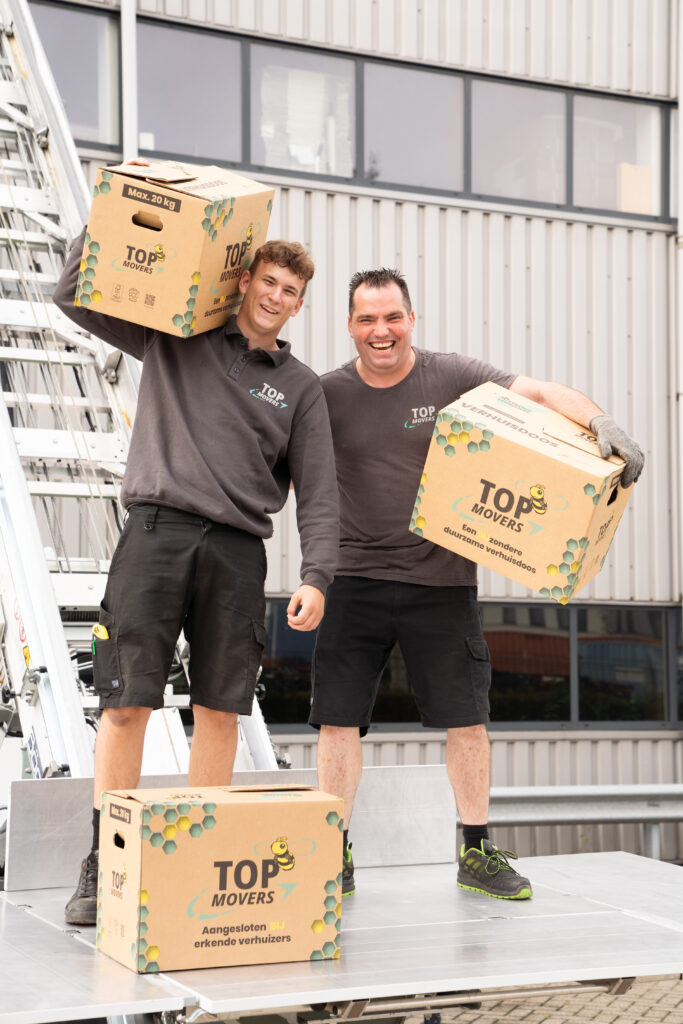
Next, opt for reusable packaging materials. Our moving boxes are made from recyclable ABS plastic and last an average of one thousand moves. After use, they are recycled, as is all other moving material. This eliminates the need for cardboard boxes that are discarded after a single use.
Finally, choosing electric transport makes a measurable difference. We operate electric trucks for the last mile, ensuring that the move itself produces no exhaust emissions in the immediate living environment of the new office.
How does a business relocation contribute to circularity and waste reduction?
A well-prepared business relocation offers a direct opportunity to process office furniture and inventory in a circular manner rather than disposing of it as waste. By drawing up a furniture passport in advance, the condition, remaining lifespan, and suitability for reuse, refurbishment, or controlled recycling is recorded for each piece of furniture.
Through our subsidiary Circular Connect, we actively work on circular relocations. The principle is simple: furniture that no longer fits the new situation does not need to go to landfill. It can be offered to other organisations, refurbished for a second life, or recycled responsibly so that the raw materials re-enter the supply chain.
This has two direct benefits for a company. First, the waste stream decreases, along with the costs of disposal. Second, it provides demonstrable evidence of circular action, which is becoming increasingly important for sustainability reporting and stakeholder communication. A sustainable business relocation is therefore not only environmentally friendly but also commercially sound.
What are the CSRD implications for companies that are relocating?
The Corporate Sustainability Reporting Directive (CSRD) requires an increasing number of companies to report on their environmental impact, including the CO2 emissions from operational activities such as relocations. A business relocation that is not documented in terms of emissions, waste streams, and material use can create a gap in the sustainability report.
In 2026, large enterprises and listed medium-sized companies will already be subject to CSRD reporting obligations. Smaller organisations in their supply chain feel the pressure indirectly, as large clients increasingly request sustainability performance data from their suppliers and partners. This also applies to facility managers and project leaders organising an office relocation: they must be able to demonstrate that the move was carried out responsibly.
In practical terms, this means the moving partner must be able to provide emissions data, material flows, and circular processing information in a format that is usable for CSRD reporting. We actively support our business clients with this documentation, so that the relocation not only runs smoothly but can also be fully and responsibly reported.
How do you choose a moving partner that truly works sustainably?
A moving partner that truly works sustainably demonstrates this with concrete certifications, measurable environmental performance, and transparency about the materials and transport used. Always ask about the ISO 14001 certificate, the CO2 performance ladder, and whether the partner has electric transport and circular processing options for furniture.
Certifications are a good starting point, but not the end point. Also ask what concretely happens to waste and furniture that does not move to the new premises, how emissions data are tracked, and whether the partner can support CSRD reporting. A moving partner who is vague about this likely does not have a robust sustainability approach.
We work with ISO 14001, ISO 9001, and the CO2 performance ladder, operate electric trucks, and our storage facility in Spijkenisse has an A+++ sustainability classification. Moreover, our 680 solar panels represent a concrete investment in CO2-neutral business operations. Through Circular Connect, we offer demonstrable circular solutions for office furniture. View our complete business services offering for an overview of our approach.
Can employees contribute to a more sustainable relocation?
Yes, employees can make a substantial contribution to a more sustainable business relocation, particularly by actively participating in the pre-selection of what moves, transporting personal workstation items themselves, and being mindful about packaging materials.
The greatest gain lies in the preparation. When employees go through their own workstations and set aside unnecessary items for reuse or recycling, the total moving volume decreases. That means fewer trips, less fuel, and less packaging material. An internal awareness campaign around the relocation, however simple, therefore has a directly measurable effect on the overall sustainability performance of the move.
Employees can also be involved in decisions about office furniture. Which chairs or desks are still good enough for reuse? Are there colleagues who want to take certain items? These kinds of internal circular flows are easy to organise and reduce the waste stream without additional costs.
How much more does a sustainable business relocation cost compared to a standard relocation?
A sustainable business relocation does not need to be structurally more expensive than a standard relocation. The additional costs of electric transport and certified material use are in many cases offset by lower disposal costs for furniture, less packaging material, and more efficient planning through thorough preparation.
It is fair to say that specific sustainable services such as a furniture passport, circular processing via Circular Connect, or comprehensive CSRD documentation require an investment. But that investment does not stand alone: organisations save on waste costs, avoid fines or reputational damage from incomplete sustainability reporting, and can actively use the relocation as a demonstrable example of circular action towards stakeholders.
The question is therefore less “how much more does sustainable relocation cost?” and more “what does it cost if the relocation is not sustainably documented?” For organisations that fall under the CSRD or that have sustainability as a strategic priority, this is a real business consideration. We are happy to help map out the total costs and benefits of a sustainable approach, so that you can make a well-informed decision.
Veelgestelde vragen
Hoe lang duurt de voorbereiding van een duurzame bedrijfsverhuizing gemiddeld?
Een duurzame bedrijfsverhuizing vraagt om meer voorbereidingstijd dan een standaard verhuizing, maar dat loont. Reken op minimaal vier tot acht weken voor een grondige inventarisatie van meubilair, het opstellen van een meubelpaspoort en het afstemmen van circulaire verwerkingsopties. Hoe eerder u begint, hoe meer ruimte er is om meubilair aan te bieden aan andere organisaties via platforms zoals Circular Connect, wat direct bijdraagt aan lagere afvoerkosten.
Wat is een meubelpaspoort precies en hoe vraag ik dat aan?
Een meubelpaspoort is een gestructureerd overzicht per meubelstuk waarin de staat, resterende levensduur en het meest geschikte verwerkingspad worden vastgelegd: hergebruik, revitalisering of gecontroleerde recycling. Het wordt opgesteld tijdens een voorinspectie op locatie, waarbij een specialist elk meubelstuk beoordeelt. U vraagt dit aan via uw verhuispartner; wij voeren deze inventarisatie uit als onderdeel van onze circulaire verhuisaanpak via Circular Connect.
Wat als mijn nieuwe kantoor kleiner is dan het huidige — wat gebeurt er dan met het overtollige meubilair?
Dit is precies de situatie waarvoor circulaire verhuisoplossingen het meeste waarde bieden. Overtollig meubilair hoeft niet naar de stort: via Circular Connect kan het worden aangeboden aan andere organisaties, worden opgeknapt voor een tweede leven of op een verantwoorde manier worden gerecycled. U ontvangt documentatie van de verwerking, wat direct bruikbaar is als bewijs van circulair handelen in uw duurzaamheidsrapportage.
Hoe weet ik zeker dat de CO2-uitstootdata van mijn verhuizing betrouwbaar zijn voor mijn CSRD-rapportage?
Vraag uw verhuispartner expliciet om gevalideerde emissiedata die zijn opgesteld conform erkende meetmethodieken, zoals de GHG Protocol-standaard. Betrouwbare partners werken met de CO2-prestatieladder en kunnen transportemissies, materiaalstromen en afvalverwerking inzichtelijk maken in een gestructureerd format. Wij leveren deze data actief aan onze zakelijke klanten, zodat de informatie direct kan worden opgenomen in de CSRD-rapportage zonder dat u zelf hoeft te reconstrueren wat er tijdens de verhuizing is gebeurd.
Kan een duurzame bedrijfsverhuizing ook worden ingezet als communicatiemiddel richting medewerkers en klanten?
Absoluut — een goed gedocumenteerde duurzame verhuizing biedt concrete en tastbare communicatiemogelijkheden. Denk aan interne updates over het aantal vermeden kilo’s afval, de CO2-besparing door elektrisch transport of het aantal meubelstukken dat een tweede leven heeft gekregen. Extern kunt u dit inzetten in stakeholdercommunicatie, duurzaamheidsverslagen of op uw website als aantoonbaar voorbeeld van circulair handelen, wat steeds meer gewicht krijgt bij klanten, investeerders en aanbestedende partijen.
Wat zijn de meest gemaakte fouten bij het plannen van een duurzame kantoorverhuizing?
De meest voorkomende fout is te laat beginnen met de inventarisatie van meubilair en inventaris, waardoor er geen tijd meer is voor circulaire verwerking en alles toch als afval wordt afgevoerd. Een tweede veelgemaakte fout is het niet betrekken van medewerkers, waardoor het totale verhuisvolume onnodig hoog blijft. Tot slot kiezen organisaties soms voor een verhuispartner op basis van prijs alleen, zonder te controleren of die partner daadwerkelijk emissiedata en circulaire documentatie kan aanleveren die voldoen aan rapportagevereisten.
Is een duurzame bedrijfsverhuizing ook relevant voor kleinere organisaties die niet onder de CSRD vallen?
Ja, ook voor kleinere organisaties is duurzaam verhuizen relevant, al is de motivatie vaak pragmatischer dan regelgeving. Lagere afvoerkosten, minder verpakkingsmateriaal en een efficiëntere planning leveren directe kostenbesparingen op. Bovendien neemt de indirecte druk vanuit de keten toe: grote opdrachtgevers vragen steeds vaker aan hun leveranciers en partners om inzicht in duurzaamheidsprestaties, ook als die partners zelf nog niet rapportageplichtig zijn onder de CSRD.
Gerelateerde artikelen
- The ultimate checklist for choosing a commercial moving company
- What are the most common mistakes when emigrating to Spain?
- Zero emissie verhuizen: wat betekent het en wanneer is het verplicht?
- Wat zijn de voordelen van uitbestede logistiek bij een bedrijfsverhuizing?
- Van demontage tot herinstallatie: zo werkt professioneel cable management bij een verhuizing
- Wat zijn de beste tools om een bedrijfsverhuizing te organiseren?
- How to choose the right removal company for a move to Spain?
- Retiring to Spain: how to choose the right removal company?
- Wat moet je regelen voor de beveiliging van je nieuwe pand?
- Wie regelt de kabels bij een bedrijfsverhuizing? Dit moet je vooraf afspreken
- Wat zijn de aandachtspunten bij een bedrijfsverhuizing in de zomer?
- Hoe weet je waar je spullen zijn tijdens een internationale verhuizing?
- Wat doet een internationaal verhuisbedrijf precies voor je?
- Hoe lang duurt een verhuizing van Nederland naar Spanje?
- Wanneer heb je een relocation service nodig bij een internationale verhuizing?