
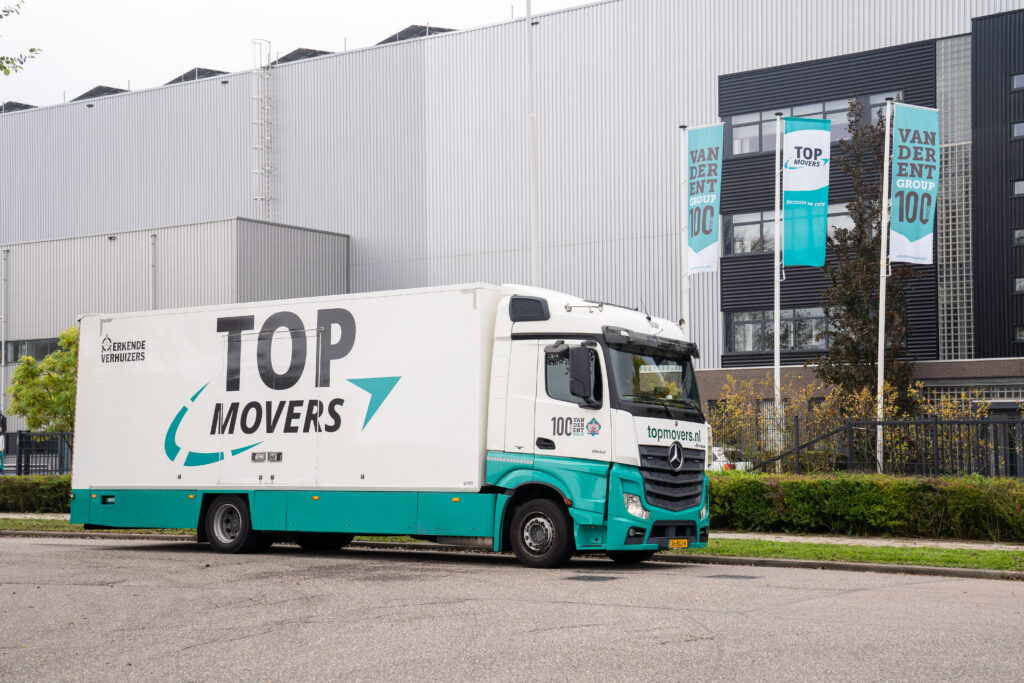
The Dutch truck toll (vrachtwagenheffing) charges trucks per kilometre driven on Dutch roads, with a rate that depends on the truck’s weight, emission class and CO2 performance. Zero-emission trucks pay the lowest rate and the oldest diesel trucks pay the highest. Specific rates are set by the Dutch government and can change, so always check the latest official tariffs before you plan your budget.
For businesses that move goods or office furniture, the toll turns road transport into a more variable cost. Below, we answer the most common questions about what determines the rate, who pays, and how you can limit the impact.
What determines the truck toll rate per kilometre?
The truck toll rate per kilometre depends mainly on three factors: the truck’s maximum weight, its emission class and its CO2 performance. Cleaner trucks pay less, heavier and more polluting trucks pay more. This follows the “polluter pays” principle, which the Netherlands applies to push the sector toward cleaner vehicles.
In practice, the rate is built from these elements:
- Vehicle weight and axle configuration: heavier trucks cause more road wear, so they pay a higher base rate.
- Euro emission class: a modern Euro VI truck pays less than an older Euro V or Euro IV truck.
- CO2 emission class: trucks with lower CO2 output fall into a more favourable tariff group.
- Zero-emission status: fully electric or hydrogen trucks receive the lowest tariff, and the government has linked this to its goal of making freight transport more sustainable.
Because the system links price to vehicle type, two trucks driving the same route can receive very different bills. Your fleet composition therefore matters as much as your total mileage.
How much will the truck toll add to a transport bill?
The extra cost depends on the number of kilometres driven in the Netherlands and on the tariff class of the truck. A fully electric truck adds only a small amount per kilometre, while an older diesel truck adds noticeably more. Multiply the tariff by your yearly mileage to see the real impact on your transport budget.
To estimate the effect on your own operation, follow these steps:
- Check the current official tariff for each truck type in your fleet or in your carrier’s fleet.
- Calculate the average kilometres per job or per month on Dutch roads.
- Multiply kilometres by the tariff and compare the total with your current transport costs.
- Repeat the calculation for a cleaner vehicle type to see the potential saving.
For a one-off office relocation within the Rotterdam port area, the added toll per move is usually modest because the distances are short. For recurring routes, such as daily distribution or long-haul freight, the costs add up quickly. Short urban trips with many stops carry a different cost profile than motorway-heavy routes, so look at your own route patterns instead of relying on an average.
Who ends up paying the truck toll?
The transport company pays the toll first, but most carriers pass it on to their customers through higher rates or a separate toll surcharge. In the end, shippers, businesses and often consumers carry the cost. How much you absorb depends on your contract terms and on how your carrier charges for it.
Three common models appear in practice:
- Separate toll surcharge: the carrier lists the toll as its own line on the invoice, which keeps the cost transparent.
- Built into the kilometre or hourly rate: the toll disappears into a higher base price.
- Fixed-price contracts: the carrier may carry the risk until the contract is renegotiated.
Ask your carrier early how they handle the toll. A transparent surcharge makes it easier to compare quotes and to see where savings are possible.
How does the truck toll affect the logistics sector?
The truck toll raises operating costs for road transport, speeds up the shift to cleaner vehicles and puts pressure on margins, especially for smaller carriers with older fleets. At the same time, it rewards companies that already invest in zero-emission trucks and smarter route planning. The sector will likely become cleaner, but also more expensive in the short term.
Several effects are already visible or likely:
- Fleet renewal: carriers have a financial reason to replace older diesel trucks with cleaner or electric models.
- Higher transport prices: costs move down the chain to shippers and customers.
- Efficiency focus: fuller loads, fewer empty kilometres and better routing become more valuable.
- Competitive shifts: carriers with modern fleets gain an advantage over those who have not invested yet.
This links directly to broader sustainability goals. Companies that report under the CSRD already look closely at the emissions of their transport partners, so the toll and the reporting duty reinforce each other.
How can companies limit the impact of the truck toll?
Companies limit the impact of the truck toll by driving fewer kilometres, using cleaner vehicles and planning transport more efficiently. Choosing zero-emission trucks gives the biggest tariff advantage, while better load planning and route optimisation reduce the kilometres you pay for. Combining several measures delivers the strongest effect.
Practical measures include:
- Switch to zero-emission transport: electric trucks fall into the lowest tariff class and also support your sustainability reporting.
- Optimise routes: shorter routes and fewer detours directly cut the toll per job.
- Consolidate shipments: fuller trucks mean fewer trips for the same volume.
- Plan ahead: bundling deliveries or moves reduces last-minute extra trips.
- Review your carrier mix: work with partners that already run modern, low-emission fleets.
Start with the measure that fits your situation best. For many facility managers, choosing a partner with an electric fleet is the fastest way to keep both costs and emissions under control.
How should businesses prepare for the truck toll?
Businesses should prepare by mapping their transport kilometres, checking the emission class of the vehicles they use, and updating contracts and budgets with the toll in mind. Starting early gives you time to compare carriers, negotiate transparent terms and plan the move to cleaner transport without time pressure.
A simple preparation plan looks like this:
- Take stock: list your regular transport flows, routes and volumes.
- Ask your carriers: find out which vehicle types they use and how they charge the toll.
- Adjust your budget: add a toll line to your transport and relocation budgets.
- Review contracts: agree on clear rules for passing on toll costs.
- Connect it to your CSRD plans: use the same data for your emissions and sustainability reporting.
If you plan an office relocation in the coming year, include the toll in your quote comparison from the start, so you avoid surprises on the final invoice.
Hoe wij helpen bij de vrachtwagenheffing en andere wetswijzigingen
Nieuwe regels zoals de vrachtwagenheffing maken transport lastiger te voorspellen. Wij ontzorgen je daarbij. Als familiebedrijf met meer dan 100 jaar ervaring (sinds 1922) en hofleverancier des Koningshuizes helpen we jullie om kosten en uitstoot onder controle te houden.
- Zero-emissietransport: we rijden met elektrische vrachtwagens, zodat jullie profiteren van schoner en toekomstbestendig vervoer.
- Duurzaam georganiseerd: we werken CO2-neutraal, met 680 zonnepanelen, ISO 14001 en de CO2-prestatieladder.
- Ondersteuning bij CSRD-rapportage: we leveren inzicht in uitstoot en hergebruik, onder meer met een meubelpaspoort via Circular Connect.
- Volledige ontzorging: van verhuisregie en een uitgebreide verhuischecklist tot opslag, cable management en handyman services.
- Transparante afspraken: we bespreken vooraf wat jullie verhuizing kost, inclusief de gevolgen van nieuwe regelgeving.
Plan je een kantoorverhuizing of bedrijfsverhuizing? Neem contact met ons op voor een vrijblijvend gesprek. We denken graag met je mee over een duurzame en voorspelbare aanpak.
Veelgestelde vragen
Where can I find the current official truck toll tariffs?
The tariffs are set by the Dutch government and published on official government and Rijksdienst voor Ondernemend Nederland (RVO) channels. Since rates can change, check these sources before every budgeting round or contract renewal. Save the tariff table for each vehicle class you use so you can quickly update your calculations.
How do I find out the emission class of the truck my carrier will use for my move?
Simply ask your carrier for the Euro emission class, CO2 class and zero-emission status of the vehicles they plan to deploy, and request this in writing in your quote. A reliable carrier can answer this immediately because it also determines their own toll costs. If they cannot say which vehicle type will be used, that is a good reason to ask more questions or compare other providers.
What if my fixed-price contract was signed before the truck toll came into effect?
Check whether your contract contains an indexation or change-in-law clause that allows the carrier to pass on new government charges. If it does not, the carrier may carry the risk until renewal, but expect the toll to be included in the next negotiation. Open the conversation early and agree on a clear, transparent method, such as a separate toll line on the invoice.
How can I check that a toll surcharge on my invoice is fair?
Ask the carrier to show the kilometres driven on Dutch roads, the vehicle’s tariff class and the rate applied. Multiply these yourself and compare the result with the surcharge on the invoice. A transparent carrier will gladly provide this breakdown, and it also helps you compare quotes from different providers on equal terms.
Is switching to electric transport really cheaper when the toll is the only factor I compare?
On the toll alone, zero-emission trucks pay the lowest rate, so the tariff advantage is clear. However, total cost also includes the carrier’s rate, availability and the value of lower emissions for your CSRD reporting. Compare complete quotes, including toll and emission data, rather than looking at the toll line in isolation.
How do I get started if I have no data on my current transport kilometres?
Start with a simple inventory: list your recurring deliveries, moves and routes for the past 6 to 12 months, using invoices and delivery notes from your carriers. Estimate the average kilometres per job in the Netherlands and multiply by the number of jobs. Even a rough baseline lets you add a toll line to your budget and gives you data for your CSRD reporting.
Does the truck toll matter for a one-off office relocation?
Yes, but the impact is usually limited for a single move over a short distance, as the toll is charged per kilometre. It is still smart to ask for the toll to be shown separately in your quote so you can compare providers fairly. Bundling the move into as few trips as possible, with good planning of the loading and routes, keeps the cost down further.
Gerelateerde artikelen
- Overuren in de transportsector: wanneer heb je recht op een overwerkvergoeding?
- When Are You Entitled to Overtime Pay? Possible New Rules After 8 Hours of Work
- Hoe ga je om met lopende projecten tijdens een bedrijfsverhuizing?
- The ultimate checklist for choosing a commercial moving company
- Hoe kies je een verhuisbedrijf voor een zorginstelling?
- What are the tax consequences of moving back to the Netherlands from Spain?
- Hoe bereid je medewerkers voor op een nieuwe werkomgeving?
- Hoe pak je een spoedeisende bedrijfsverhuizing aan?
- Wat is de beste periode in het jaar voor een bedrijfsverhuizing?
- Wat moet je regelen bij de gemeente voor een bedrijfsverhuizing?
- Hoe houd je de bedrijfsvoering draaiende op de dag van de verhuizing?
- Hoe maak je een checklist voor een bedrijfsverhuizing?
- Kun je je inboedel tijdelijk opslaan bij een terugverhuizing vanuit Spanje?
- Hoe groot is een verhuiscontainer voor een internationale verhuizing?
- Hoe vind je een sociaal netwerk na een verhuizing naar het buitenland?