

A moving company is truly sustainable when it provides concrete, verifiable evidence: recognised certifications, measurable CO2 reduction, and demonstrable circular policies. You can identify greenwashing by vague promises without substantiation, missing certificates, and sustainability claims that are never quantified. This article answers the most important questions every facilities manager or project leader should ask before choosing a moving partner.
What concrete evidence demonstrates that a moving company is genuinely sustainable?
A sustainable moving company demonstrates its performance through independently verified certifications, measurable environmental targets, and transparent reporting. Think of ISO 14001 for environmental management, the CO2 Performance Ladder, and VCA certification. Without these quality marks, sustainability claims are nothing more than marketing language.
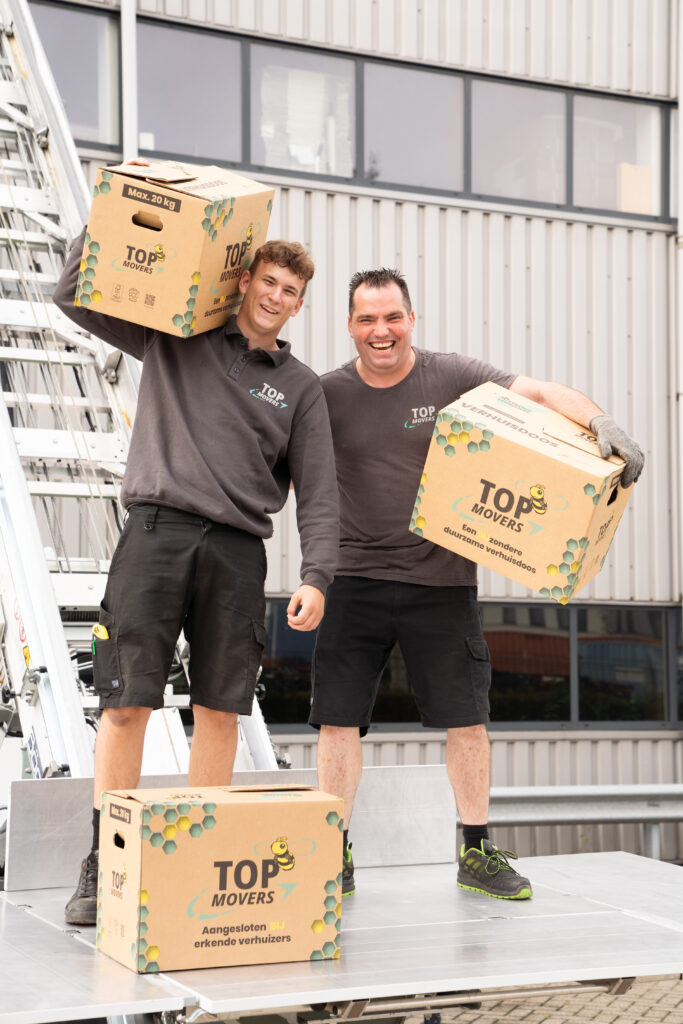
Beyond paper certificates, there are also practical signals that reveal genuine sustainability. Does the company operate electric vehicles, or do its vehicles at least meet the applicable European environmental standards? Is moving material reused or recycled? We work with moving boxes made from recyclable ABS plastic that last an average of 1,000 moves and are then recycled. Our moving materials are reused at a rate of 98%.
The company’s premises themselves also tell a story. Our storage facility in Spijkenisse has an A++++-sustainability classification and the roof is covered with 680 solar panels. These are not intentions — these are facts you can verify. Ask every potential moving partner for their latest sustainability report or CO2 reporting. A company that is truly sustainable shares that information without hesitation.
What are the most common greenwashing tactics in the moving industry?
The most common greenwashing tactics in the moving industry are: vague terms such as “green” or “eco-friendly” without explanation, citing one sustainable measure as proof of an entirely sustainable business operation, and the absence of independent verification for claims made.
In practice, you can see this in the following patterns:
- Vague language: “We are consciously working on the environment” says nothing. Always ask: conscious in what way, measured how, and verified by whom?
- One green measure as a smokescreen: A company that has one electric van but otherwise drives outdated diesel vehicles is not sustainable. That is one measure, not a policy.
- Missing certification: Sustainable business operations are assessed by independent parties. No ISO 14001, no CO2 Performance Ladder, and no recognised quality marks is a clear signal.
- No concrete targets: A truly sustainable company works with measurable goals and reports on them. “We aim for lower emissions” is not a target.
- Sustainability only in communications, not in services: If the moving company offers no circular options for office furniture, cannot deploy zero-emission transport, and provides no support for sustainability reporting, the green story does not add up.
What questions should you ask a moving company about sustainability?
The right sustainability questions to ask a moving company are: which environmental certificates do you hold, how do you measure your CO2 emissions per move, can you deploy zero-emission transport, and how do you handle office furniture that is not being relocated? These questions distinguish a serious partner from a company that merely engages in green marketing.
Use the checklist below as a guide during an initial conversation:
- Which certifications do you hold in the areas of environment and quality (ISO 14001, ISO 9001, CO2 Performance Ladder)?
- Do you have electric or zero-emission transport available for our move?
- How do you report on the CO2 emissions of a move, and can you include that in our own sustainability reporting?
- What happens to office furniture we are not taking with us? Do you offer reuse, refurbishment, or responsible disposal?
- What percentage of your moving materials is reused or recycled?
- Do you have experience with CSRD reporting, or can you supply data that fits into our scope 3 emissions calculations?
A moving company that answers all of these questions concretely and without hesitation deserves trust. If the answer remains vague or the question is avoided, you know enough.
How does CSRD regulation relate to the choice of a moving partner?
Under the CSRD regulation (Corporate Sustainability Reporting Directive), an increasing number of organisations are required to report on their full CO2 footprint, including emissions from purchased services such as a business relocation. This falls under so-called scope 3 emissions. The choice of a moving partner is therefore directly relevant to your sustainability reporting.
In practice, this means you expect your moving company to supply emissions data that aligns with your reporting structure. If the company cannot quantify the CO2 emissions of your move, you will face a problem with your annual reporting. That risk is only increasing as CSRD obligations come into force for a larger group of companies in 2026.
A moving partner that actively contributes to your sustainability objectives offers more than just transport. Think of support in drawing up a furniture passport, which makes the lifecycle and reuse possibilities of office furniture transparent. Or zero-emission transport that directly contributes to lower scope 3 emissions. For organisations in sectors where CSRD already applies, such as the petrochemical industry and the Port of Rotterdam, this is not a niche consideration but a serious selection criterion.
What distinguishes a sustainable office relocation from a standard move?
A sustainable office relocation distinguishes itself from a standard move through the use of zero-emission transport, a circular approach to office furniture, the use of reusable moving materials, and the ability to supply CO2 data for sustainability reporting. A standard move transports items from A to B; a sustainable move does so with as little impact as possible on people and the environment.
In practice, you can see the difference in the following areas:
- Transport: Zero-emission or electric vehicles instead of standard diesel trucks, especially for the last mile.
- Furniture: A furniture passport records which furniture can be reused, which pieces are due for refurbishment, and what must be responsibly disposed of. Nothing goes to landfill unnecessarily.
- Moving materials: Reusable moving boxes and eco-friendly alternatives to bubble wrap and packing paper instead of single-use plastic.
- Reporting: Upon completion, you receive insight into the CO2 emissions of the move, usable for your own corporate sustainability reporting.
- Circular processing: Residual streams are reused or recycled as much as possible through a network of partners, keeping raw materials within the supply chain.
The difference lies not only in the execution but also in the preparation. A sustainable move begins with a thorough inventory: what is coming along, what gets a second life, and what leaves the supply chain responsibly. That requires a partner who actively guides this process and does not merely carry the boxes.
Veelgestelde vragen
Hoe controleer ik of een CO2-prestatieladder certificering van een verhuisbedrijf nog geldig is?
U kunt de geldigheid van een CO2-prestatieladder certificering eenvoudig controleren via het openbare register op de website van SKAO (Stichting Klimaatvriendelijk Aanbesteden u0026 Ondernemen). Zoek het bedrijf op naam op en controleer het certificaatniveau en de verloopdatum. Een betrouwbaar verhuisbedrijf geeft u dit certificaatnummer proactief mee en moedigt u aan het zelf te verifiëren.
Wat als een verhuisbedrijf geen elektrisch transport kan inzetten in onze regio — is de verhuizing dan alsnog duurzaam te maken?
Ja, ook zonder volledig elektrisch transport zijn er betekenisvolle stappen mogelijk. Denk aan het optimaliseren van ritplanning om het aantal ritten te minimaliseren, het inzetten van Euro 6-voertuigen als schoonste alternatief, het gebruik van herbruikbaar verhuismateriaal en een circulaire aanpak voor meubilair. Vraag het verhuisbedrijf welke compenserende maatregelen het neemt en of het de resterende uitstoot kan kwantificeren voor uw rapportage.
Hoe neem ik de CO2-data van een bedrijfsverhuizing op in onze CSRD-rapportage?
Verhuisemissies vallen onder scope 3, categorie 1 (ingekochte goederen en diensten) of categorie 4 (upstream transport en distributie), afhankelijk van de interpretatie binnen uw rapportagestructuur. Vraag uw verhuispartner om een emissieoverzicht in kilogram CO2-equivalent, bij voorkeur berekend volgens de GHG Protocol-methodiek. Stem dit vervolgens af met uw ESG-adviseur of controller om de data correct te verwerken in uw jaarverslag.
Wat is een meubelpaspoort en hoe vraag ik dit aan bij een verhuizing?
Een meubelpaspoort is een digitaal of fysiek document dat per meubelstuk de materiaalsamenstelling, herkomst, staat en hergebruiksmogelijkheden vastlegt. Het stelt u in staat om bij een verhuizing bewuste keuzes te maken: wat gaat mee, wat wordt gerevitaliseerd en wat wordt verantwoord afgevoerd of gedoneerd. U vraagt dit aan door het expliciet op te nemen in uw offerteaanvraag; niet elk verhuisbedrijf biedt dit standaard aan, dus het is een direct onderscheidend criterium bij uw selectie.
Welke veelgemaakte fouten maken facilitair managers bij het selecteren van een duurzame verhuispartner?
De meest voorkomende fout is vertrouwen op het groene imago van een bedrijf zonder de onderliggende bewijzen op te vragen, zoals certificaten, CO2-rapportages of concrete hergebruikscijfers. Een tweede veelgemaakte fout is duurzaamheid niet meenemen in de offerteaanvraag, waardoor verhuisbedrijven alleen op prijs concurreren en duurzame opties buiten beeld blijven. Formuleer duurzaamheidseisen expliciet in uw programma van eisen en weeg ze mee als formeel gunningscriterium.
Kan een kleinere organisatie die nog niet CSRD-plichtig is ook profiteren van een duurzame bedrijfsverhuizing?
Absoluut. Ook zonder CSRD-verplichting levert een duurzame verhuizing directe voordelen op: lagere afvalkosten door hergebruik van meubilair, een betere ESG-score voor stakeholders en klanten, en een aantoonbare bijdrage aan uw eigen klimaatdoelstellingen. Bovendien wordt de groep CSRD-plichtige organisaties in 2026 aanzienlijk uitgebreid, waardoor vroeg beginnen met het verzamelen van emissiedata u later veel werk bespaart.
Hoe vergelijk ik duurzaamheidsaanbiedingen van meerdere verhuisbedrijven objectief met elkaar?
Stel een gestandaardiseerde vragenlijst op met meetbare criteria: het type en aantal certificeringen, het percentage herbruikbaar verhuismateriaal, de beschikbaarheid van emissievrij transport en de mogelijkheid tot CO2-rapportage per verhuizing. Vraag elk bedrijf dezelfde vragen te beantwoorden met onderbouwing, en weeg de antwoorden naast de prijs. Bedrijven die concrete cijfers en certificaatnummers aanleveren, scoren hoger dan bedrijven die volstaan met algemene duurzaamheidsbeloftes.
Gerelateerde artikelen
- What are common mistakes during a business relocation?
- Hoe werkt aanbesteden versus onderhands gunnen bij een kantoorverhuizing?
- Hoe bereid je een bedrijfsverhuizing goed voor?
- Waarom kiezen bedrijven voor een verhuis-, opslag- en logistiekbedrijf?
- Hoe verwerk je een bedrijfsverhuizing in je CSRD-rapportage?
- How do you deal with homesickness after emigrating?
- Hoe update je al je communicatiemiddelen na een bedrijfsverhuizing?
- Wat kost het inhuren van een verhuisbedrijf voor een bedrijfsverhuizing?
- Hoe vergelijk je offertes van verhuisbedrijven voor een bedrijfsverhuizing?
- Wat moet je als eerste regelen bij een verhuizing naar het buitenland?
- Is een verhuiskostenvergoeding van de werkgever belast in Nederland?
- Hoe werkt een verhuiskostenvergoeding bij een verhuizing naar het buitenland?
- Wat doet een internationaal verhuisbedrijf precies voor je?
- Wat is een relocation service en wat doet die precies?
- Wat dekt een verhuisverzekering precies?