

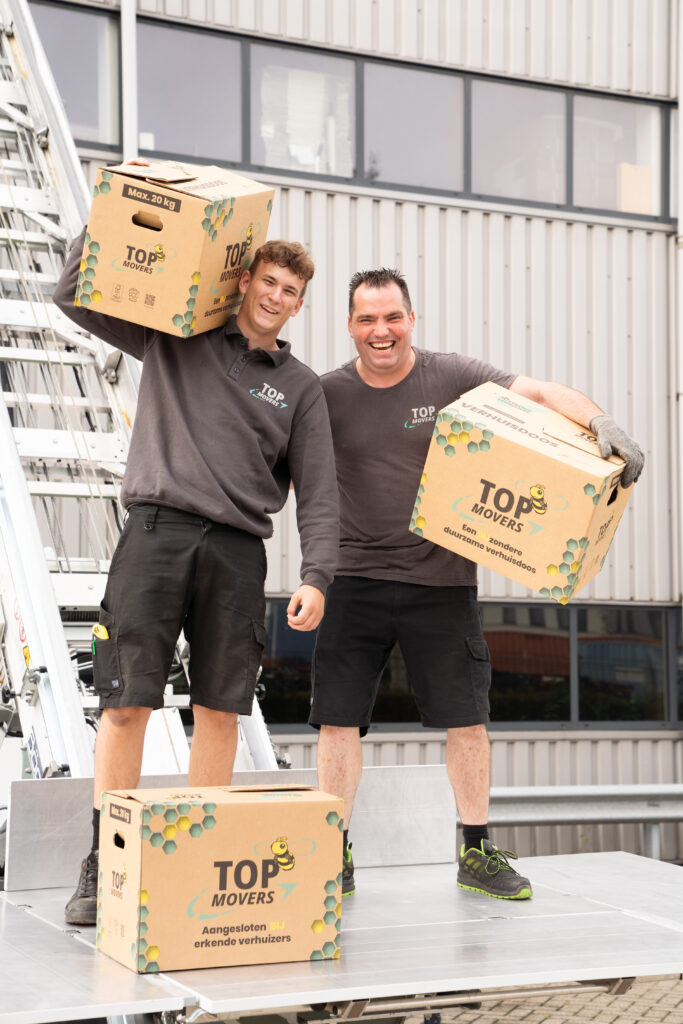
For a business relocation, you use reusable packaging by renting standardised plastic moving boxes instead of ordering single-use cardboard. The boxes are delivered before the move, packed by the moving company, and collected and cleaned afterwards for reuse. This works more efficiently, is more cost-effective at the project level, and fits directly into a sustainable business policy.
For facility managers and office managers who are planning an office relocation, the choice for reusable packaging materials is increasingly a deliberate strategic decision, partly driven by CSRD obligations and internal sustainability targets. In this article, we answer the most frequently asked questions about reusable packaging for business relocations.
What are the benefits of reusable packaging for an office relocation?
Reusable packaging offers three direct benefits for an office relocation: less waste, lower total costs at the project level, and a demonstrable contribution to sustainability goals. Because the boxes are stackable and standardised, packing, loading, and unloading also proceed faster than with irregular cardboard boxes.
Cardboard moving boxes are discarded after a single use in the average office relocation. This generates a significant amount of waste, especially for larger organisations. Reusable plastic boxes are collected after the move, cleaned, and put back into use. Our moving boxes are made from recyclable ABS plastic and have an average lifespan of around 1,000 moves. After that lifespan, they are recycled, so the material itself is not lost either.
Practically speaking, the boxes are also more robust: they protect the contents better against moisture and impact, close securely, and are easy to label. For employees packing their own desks, a stack of identical boxes with clear closures is more manageable than a collection of cardboard boxes in varying sizes.
What types of reusable packaging are available for business relocations?
For business relocations, several types of reusable packaging are available, depending on what needs to be moved. The most commonly used are closed plastic moving boxes for office supplies and archives, wardrobe boxes on wheels for clothing, and padded transport crates for equipment and monitors.
An overview of the most common options:
- Plastic moving boxes: suitable for office supplies, books, folders, and employees’ personal belongings. The standardised size makes stacking straightforward.
- Hanging wardrobe boxes: for wardrobes and formal clothing that needs to be moved without creasing.
- Computer boxes and monitor crates: specially designed for IT equipment, with built-in protection.
- Archive boxes: for document folders and paper archives, often fitted with a lockable lid.
- Furniture dollies and moving blankets: technically not boxes, but also reusable tools for protecting furniture during transport.
Some moving companies also offer eco-friendly alternatives to bubble wrap and packing paper. Think of reusable packing materials made from textile or recycled fibres. This fits into a broader approach where the protective materials are also part of the circular move.
How do you plan the use of reusable packaging efficiently?
Efficient use of reusable packaging starts with a thorough inventory: how many boxes do you need, when will they be delivered, and when will they be collected? Align this with the relocation schedule, so employees do not pack too early and the boxes do not sit unused on the work floor for too long.
A practical step-by-step approach:
- Assess the scope: count the number of workstations and estimate the number of boxes needed per employee. Also factor in what will be taken from shared spaces.
- Plan the delivery date: have the boxes delivered two to three working days before the move, giving employees enough time to pack without disrupting the workplace for too long.
- Communicate internally: give employees clear instructions on how to pack, what to label, and what to set aside for the movers.
- Coordinate the collection: agree on a collection moment with the moving company, preferably one to two days after arrival at the new location.
Good relocation coordination is essential here. For every business relocation, we draw up a comprehensive moving checklist, so that the logistics around packaging are also well embedded in the overall relocation process.
How does reusable packaging contribute to CSRD reporting?
Reusable packaging contributes to CSRD reporting by demonstrably reducing waste and cutting the use of single-use raw materials. These are concrete, measurable environmental indicators that fit within the reporting obligations of the Corporate Sustainability Reporting Directive.
For organisations subject to CSRD regulations, it is increasingly important to account for indirect activities such as a business relocation. A relocation in which only reusable boxes are used generates fewer waste streams than a relocation using cardboard. This is documentable and therefore usable as supporting evidence in a sustainability report.
Beyond the packaging itself, other aspects of the relocation also play a role. Electric transport results in lower CO2 emissions. Through our subsidiary network Circular Connect, we offer support in mapping office furniture via a furniture passport, making the reuse and revitalisation of furniture demonstrable as well. Together, this provides a complete picture of the environmental impact of the relocation, which can be directly used for CSRD reporting.
What does it cost to rent reusable moving boxes for an office relocation?
The cost of renting reusable moving boxes for an office relocation depends on the number of boxes, the rental period, and the associated services. In most cases, the boxes are offered as part of the overall relocation package, not as a separate line item.
It is worthwhile to compare the cost of reusable boxes with the alternative cost of cardboard boxes. With cardboard, you pay for the purchase, the packing materials, and the disposal. With reusable boxes, disposal is eliminated and the material is more robust, which can prevent damage to inventory. The total costs are therefore often comparable, while the sustainability gain is considerably greater.
We advise explicitly requesting information about the use of reusable packaging when obtaining a quote for a business relocation, and what this entails in terms of delivery, use, and collection. This gives you a clear overall picture and allows you to make a well-founded case to internal stakeholders or in a tendering process.
What questions should you ask a moving company about sustainable packaging?
When selecting a moving company for a sustainable office relocation, ask the following questions about packaging: what materials do they use, how long do the boxes last, what is their policy on protective materials such as bubble wrap, and can they document the environmental impact of the packaging for reporting purposes?
A more extensive list of relevant questions:
- Do you work exclusively with reusable boxes or also with single-use cardboard?
- What is the lifespan of the moving boxes and what happens at end of life?
- Are protective materials such as packing paper and film also used sustainably?
- Can you substantiate the waste reduction from the packaging for our sustainability report?
- Is the transport emission-free or do you use electric vehicles?
- Do you offer support with CSRD-related documentation of the relocation?
- Are you ISO 14001-certified or do you hold another environmental certification?
A moving company that can answer these questions concretely and transparently demonstrates that sustainability is not a marketing term, but an operational reality. We are ISO 14001- and ISO 9001-certified, work with the CO2 Performance Ladder, and can make the environmental impact of a relocation transparent. This way, we not only take the burden off the relocation itself, but also off the reporting that goes with it.
Veelgestelde vragen
Hoe lang van tevoren moet ik herbruikbare verhuisdozen reserveren bij een kantoorverhuizing?
Het is verstandig om herbruikbare verhuisdozen minimaal vier tot zes weken voor de verhuisdatum te reserveren, zeker bij grotere kantoorverhuizingen. Populaire verhuisperiodes, zoals het einde van een kwartaal of zomermaanden, kennen een hogere vraag waardoor beschikbaarheid eerder een knelpunt kan worden. Door vroeg te reserveren, kun je ook de leveringsdatum en ophaling nauwkeurig afstemmen op je interne verhuisplanning.
Wat als een medewerker een herbruikbare verhuisdoos beschadigt of kwijtraakt?
In de meeste gevallen zijn er in het verhuurcontract afspraken opgenomen over vermissing of schade aan de dozen. Bespreek dit vooraf met het verhuisbedrijf en informeer naar eventuele eigen risico’s of vervangingskosten per doos. Het is praktisch om intern één aanspreekpunt aan te wijzen die de uitgifte en inname van dozen bijhoudt, zodat je aan het einde van de verhuizing een volledig overzicht hebt en discussies over ontbrekende dozen voorkomt.
Kunnen herbruikbare verhuisdozen ook worden ingezet bij een gefaseerde kantoorverhuizing?
Ja, herbruikbare dozen zijn juist goed geschikt voor gefaseerde verhuizingen, omdat ze na elke fase opgehaald, gereinigd en opnieuw ingezet kunnen worden. Dit betekent dat je niet voor de volledige verhuizing tegelijk dozen hoeft te huren, maar de hoeveelheid per fase kunt afstemmen. Bespreek dit scenario expliciet met het verhuisbedrijf, zodat de logistiek rondom levering en ophaling per fase goed wordt ingepland.
Zijn herbruikbare verhuisdozen ook geschikt voor gevoelig of vertrouwelijk archief?
Herbruikbare kunststof archiefboxen zijn uitstekend geschikt voor vertrouwelijk papierarchief, omdat ze voorzien zijn van een afsluitbaar deksel en robuuster zijn dan open kartonnen dozen. Voor bijzonder gevoelige documenten, zoals juridische dossiers of HR-bestanden, is het aan te raden om de dozen te voorzien van een verzegeling of nummering en de verantwoordelijkheid voor transport bij een vaste persoon te beleggen. Bespreek met het verhuisbedrijf of er aanvullende beveiligingsprotocollen beschikbaar zijn voor vertrouwelijke transporten.
Wat is het verschil tussen een verhuisbedrijf dat zegt duurzaam te werken en één dat het aantoonbaar doet?
Het verschil zit in certificering, transparantie en documentatie. Een verhuisbedrijf dat aantoonbaar duurzaam werkt, beschikt over keurmerken zoals ISO 14001, werkt met de CO2-prestatieladder en kan concrete gegevens aanleveren over afvalreductie en emissies die bruikbaar zijn voor jouw duurzaamheidsrapportage. Vraag altijd om schriftelijke onderbouwing en controleer of het bedrijf ook de milieu-impact van de verpakkingen en het transport inzichtelijk kan maken, niet alleen in algemene termen maar met meetbare indicatoren.
Kan ik als facilitair manager de keuze voor herbruikbare verpakkingen intern goed onderbouwen richting management?
Ja, en de onderbouwing is sterker dan veel managers verwachten. De totaalkosten van herbruikbare dozen liggen vaak dicht bij die van karton als je inkoop, inpakmateriaal én afvoerkosten meeneemt, terwijl de duurzaamheidswinst aanzienlijk groter is. Daarnaast levert de keuze voor herbruikbare verpakkingen aantoonbare input op voor CSRD-rapportage en interne ESG-doelstellingen, wat de businesscase ook strategisch sterk maakt naast de operationele en financiële argumenten.
Wat gebeurt er met de herbruikbare dozen als ze na duizend verhuisbewegingen aan het einde van hun levensduur zijn?
Dozen die het einde van hun levensduur bereiken worden niet weggegooid, maar aangeboden voor recycling. Omdat de dozen gemaakt zijn van recyclebaar ABS-kunststof, kan het materiaal opnieuw worden verwerkt tot nieuwe producten. Dit sluit de cirkel volledig en voorkomt dat het materiaal als afval eindigt. Voor organisaties die dit willen meenemen in hun duurzaamheidsrapportage, is het verstandig om bij het verhuisbedrijf te informeren naar documentatie over het recyclingproces van de dozen.
Gerelateerde artikelen
- Hoe zorg je dat een verhuisbedrijf aansluit op je CSRD-rapportage?
- Hoe bereid je een bedrijfsverhuizing goed voor?
- How to choose the right removal company for an international move?
- What are the most common mistakes when emigrating to Spain?
- Checklist: zo beoordeel je het social return-beleid van een verhuisbedrijf
- Hoe pak je de inrichting van een nieuw pand aan na een bedrijfsverhuizing?
- Wat zijn de voordelen van professionele begeleiding bij een bedrijfsverhuizing?
- Wat zijn de meest tijdrovende onderdelen van een bedrijfsverhuizing?
- Hoe ga je om met klanten die je nieuwe adres niet kunnen vinden?
- Wat kost tijdelijke meubelopslag voor bedrijven en wanneer loont het?
- Hoe informeer je klanten over een bedrijfsverhuizing?
- Hoe werkt een voorinspectie bij een internationale verhuizing?
- Hoe bescherm je antiek en kunst tijdens een internationale verhuizing?
- Waar wonen de meeste Nederlanders in Spanje?
- Wanneer heb je een relocation service nodig bij een internationale verhuizing?