
Removal companies take concrete steps in the areas of transport, material use, and circularity to reduce their ecological footprint. Think of electric trucks, reusable packaging materials, and programmes for the reuse of office furniture. For facilities managers and project managers planning a corporate relocation while also needing to comply with CSRD reporting requirements, choosing a demonstrably sustainable moving partner is becoming increasingly important. In this article, we answer the most frequently asked questions about sustainability in the moving industry.
What concrete measures do removal companies take for the climate?
Sustainable removal companies take measures on three fronts: cleaner transport, reusable materials, and smart logistics. In practice, this means electric or hybrid vehicles, moving boxes made from recycled plastic, and route planning that minimises empty kilometres. Together, these steps result in a measurable reduction in CO2 emissions per move.
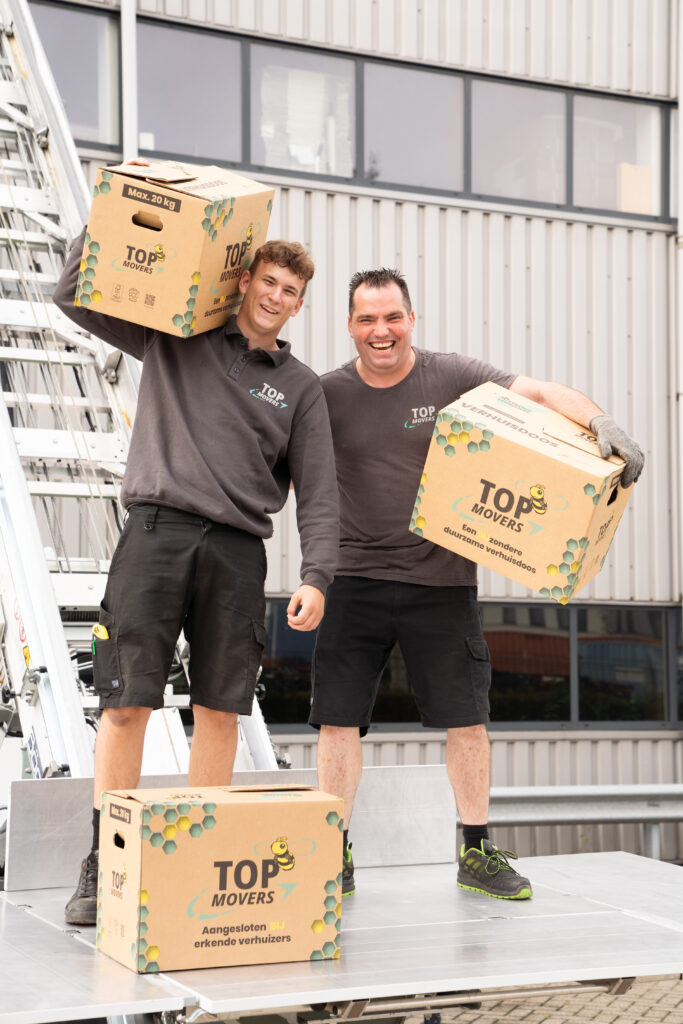
At Van der Ent, we use moving boxes made from recyclable ABS plastic that last an average of 1,000 moves before being recycled. We use eco-friendly alternatives to packing paper and bubble wrap, and 98% of our materials are reused. Our storage facility in Spijkenisse has an A++++-sustainability classification and is partly powered by solar energy, with 680 solar panels on the roof. These are not marketing words, but demonstrable choices that are reflected in our ISO 14001 certification and CO2 performance ladder.
In addition to material use, logistical efficiency plays a major role. By smartly combining routes and bundling trips, we drive fewer kilometres for the same work. That saves fuel, emissions, and costs.
What is the difference between a green and a regular removal company?
The difference lies in demonstrable choices, not in claims. A green removal company holds environmental certificates, actively measures its emissions, uses sustainable materials, and offers circular solutions for furniture. A regular removal company focuses primarily on moving belongings, without structural attention to the ecological impact of that process.
Specifically, green removal companies distinguish themselves on the following points:
- Certification: ISO 14001 for environmental management systems and operation via the CO2 performance ladder
- Fleet: electric or zero-emission vehicles, at minimum compliant with the strictest European environmental standards
- Material use: reusable packaging instead of single-use cardboard and bubble wrap
- Circularity: programmes for the reuse or refurbishment of office furniture
- Reporting: support with sustainability reporting, relevant for organisations with CSRD obligations
For business clients who must account for their supply chain emissions, the difference between the two types of removal companies is therefore not only a matter of principle, but also practically relevant.
How do removal companies reduce their CO2 emissions?
Removal companies reduce their CO2 emissions by switching to zero-emission transport, optimising logistical routes, and using sustainable materials. The greatest gain lies in the vehicle fleet: freight traffic is responsible for a significant share of emissions in the logistics sector, making electric vehicles immediately impactful.
All our removal vehicles comply with the strictest European environmental standards, and we are progressively investing in electric transport, with the goal of zero-emission moving in the last mile. This is not a distant ambition: electric trucks are already operational in our fleet. At the same time, we structurally measure our environmental performance via the CO2 performance ladder, so that improvement does not remain at good intentions but becomes visible in figures.
In addition to transport, smart planning also contributes to lower emissions. By bundling moves, running full loads, and avoiding unnecessary trips, CO2 emissions per move decrease significantly. For business clients mapping their Scope 3 emissions, we can provide that data as part of the sustainability report.
What happens to office furniture that is not being moved?
Office furniture that is not being moved does not automatically have to be discarded. Sustainable removal companies offer circular alternatives: reuse through refurbishment, resale, or donation to other organisations. This gives furniture a second life and prevents valuable raw materials from being wasted.
Through our subsidiary Circular Connect, we specifically address this issue. Circular Connect is an initiative within the Top Movers network and brings together supply and demand for second-hand office furniture. With a furniture passport, we map the capacity and life history of furniture, making it clear what can be reused, what needs to be refurbished, and what qualifies for recycling.
For facilities managers planning an office relocation, this means in practice:
- Lower waste costs through conscious repurposing of furniture
- Demonstrable contribution to circular objectives
- Documentation that can be used for CSRD reporting
- Possibility of refurbishing valuable pieces instead of replacing them
This makes choosing a circular removal company not only ecologically responsible, but also economically interesting.
How do you know if a removal company truly works sustainably?
A removal company truly works sustainably if it makes its environmental performance measurable, is independently certified, and can demonstrate concrete measures rather than merely communicating about green ambitions. Look beyond marketing texts and ask about certificates, measurement methods, and concrete results.
Reliable indicators are:
- ISO 14001 certification: an internationally recognised standard for environmental management systems, demonstrating that the company structurally manages its environmental impact
- CO2 performance ladder: a measurement tool that provides insight into how actively a company is working on CO2 reduction
- Demonstrably sustainable materials: reusable moving boxes, eco-friendly packaging materials, and no single-use plastic
- Electric or low-emission fleet: no vague commitments, but vehicles already in operation
- Circular services: concrete solutions for furniture that is not being moved, such as reuse programmes
- Transparency in reporting: the ability to provide emissions data for your own sustainability report
As a facilities manager or project manager, you can also ask about the VCA certificate, which demonstrates that a company works safely and responsibly, and about membership of recognised industry organisations such as Top Movers. These quality marks are not issued lightly and give a realistic picture of a removal company’s working methods. We meet all these criteria and are happy to assist you with the documentation you need for your own storage and reporting processes.
Veelgestelde vragen
Hoe kan ik als facilitair manager de duurzaamheidsprestaties van een verhuisbedrijf opnemen in onze CSRD-rapportage?
Vraag uw verhuispartner expliciet om een CO2-rapportage per verhuizing, inclusief een uitsplitsing naar Scope 3-emissies. Een gecertificeerd duurzaam verhuisbedrijf kan deze gegevens structureel aanleveren in een formaat dat aansluit op uw interne rapportageprocessen. Zorg er daarnaast voor dat u certificaten zoals ISO 14001 en de CO2-prestatieladder opvraagt als onderbouwend bewijs voor uw ketenverantwoordelijkheid.
Wat zijn de meest gemaakte fouten bij het selecteren van een duurzame verhuispartner voor een bedrijfsverhuizing?
De meest voorkomende fout is afgaan op groene marketingclaims zonder te vragen naar aantoonbaar bewijs, zoals certificeringen of meetbare CO2-reductiedoelstellingen. Een tweede veelgemaakte fout is duurzaamheid pas laat in het selectieproces meenemen, waardoor het geen volwaardig criterium wordt naast prijs en planning. Neem duurzaamheid al op in uw Programma van Eisen en stel gerichte vragen tijdens de offertefase.
Is een duurzame bedrijfsverhuizing duurder dan een reguliere verhuizing?
Niet per definitie. Herbruikbaar verpakkingsmateriaal, zoals kunststof verhuisboxen, elimineert de inkoopkosten van eenmalig karton en noppenfolie, wat de totaalprijs kan drukken. Circulaire oplossingen voor kantoormeubilair kunnen bovendien afvalverwerkingskosten verlagen en zelfs opbrengsten genereren via doorverkoop of revitalisering. Op projectniveau weegt de investering in duurzaamheid daardoor vaak op tegen de besparingen elders in het verhuisproces.
Hoe gaat een meubelpaspoort in de praktijk werken tijdens een kantoorverhuizing?
Een meubelpaspoort legt per meubelstuk de staat, het materiaal, de leeftijd en de hergebruiksmogelijkheden vast, zodat u vóór de verhuizing al weet wat herplaatst, gerevitaliseerd of gerecycled wordt. Dit voorkomt dat waardevolle stukken onnodig worden afgevoerd en maakt het eenvoudiger om circulaire keuzes te documenteren voor interne rapportage. In de praktijk start dit proces idealiter in de planningsfase, zodat logistiek en bestemming van meubilair op elkaar zijn afgestemd.
Wat moet ik vragen aan een verhuisbedrijf als ik wil weten of hun elektrische wagenpark echt operationeel is?
Vraag specifiek welk percentage van de ingezette voertuigen voor uw verhuizing elektrisch of emissievrij is, en niet alleen of het bedrijf elektrische voertuigen ‘in gebruik heeft’. Vraag ook naar de laadinfrastructuur en of elektrisch transport beschikbaar is voor uw specifieke locatie en afstand. Een transparant verhuisbedrijf geeft hier concrete antwoorden op en kan dit desgewenst vastleggen in de opdrachtbevestiging.
Hoe betrek ik medewerkers bij een duurzame bedrijfsverhuizing zonder de planning te vertragen?
Communiceer vroeg en concreet over de duurzame keuzes die worden gemaakt, zoals het gebruik van herbruikbare verhuisboxen in plaats van kartonnen dozen, zodat medewerkers weten wat er van hen wordt verwacht bij het inpakken. Een korte instructiegids of digitale checklist per afdeling voorkomt verwarring en bespaart tijd op de verhuisdag zelf. Door medewerkers actief te betrekken als ambassadeurs van de duurzame aanpak, versterkt u bovendien het draagvlak voor bredere duurzaamheidsdoelstellingen binnen de organisatie.
Kan een verhuisbedrijf ook ondersteunen bij de duurzaamheidsdoelstellingen van onze opslag na de verhuizing?
Ja, duurzame verhuisbedrijven bieden ook opslagoplossingen die aansluiten op uw milieudoelstellingen, zoals magazijnen met een hoge energieclassificatie, zonne-energie en efficiënt ruimtegebruik. Het is verstandig om bij de keuze voor een opslaglocatie dezelfde duurzaamheidscriteria te hanteren als bij de verhuispartner zelf, inclusief het opvragen van energielabels en certificeringen. Zo borgt u dat uw duurzame aanpak niet stopt bij de verhuisdag, maar ook de beheerfase van uw bedrijfsmiddelen omvat.
Gerelateerde artikelen
- How do you ensure a removal company aligns with your CSRD reporting?
- How do you weigh price versus quality for a business relocation?
- Wat zijn de aandachtspunten bij een bedrijfsverhuizing voor een mkb-bedrijf?
- Zero emissie verhuizen: de checklist voor een duurzame kantoorverhuizing
- How to register at the municipality in Spain when you emigrate?
- Hoe ga je om met vertrouwelijke gegevens tijdens een bedrijfsverhuizing?
- Wat is de beste periode in het jaar voor een bedrijfsverhuizing?
- Hoe voorkom je dat een bedrijfsverhuizing uitloopt?
- Wat is de beste manier om je voor te bereiden op een verhuizing naar het buitenland?
- Wat is een erkend verhuisbedrijf en waarom is dat belangrijk?
- Hoe lang kun je je inboedel opslaan bij een internationale verhuizing?
- Hoe lang duurt het om een emigratie voor te bereiden?
- Wat doet een internationaal verhuisbedrijf precies voor je?
- Wat is het verschil tussen de Spaanse en Nederlandse levensstjil?
- Wat zijn de kosten van levensonderhoud in Spanje vergeleken met Nederland?