

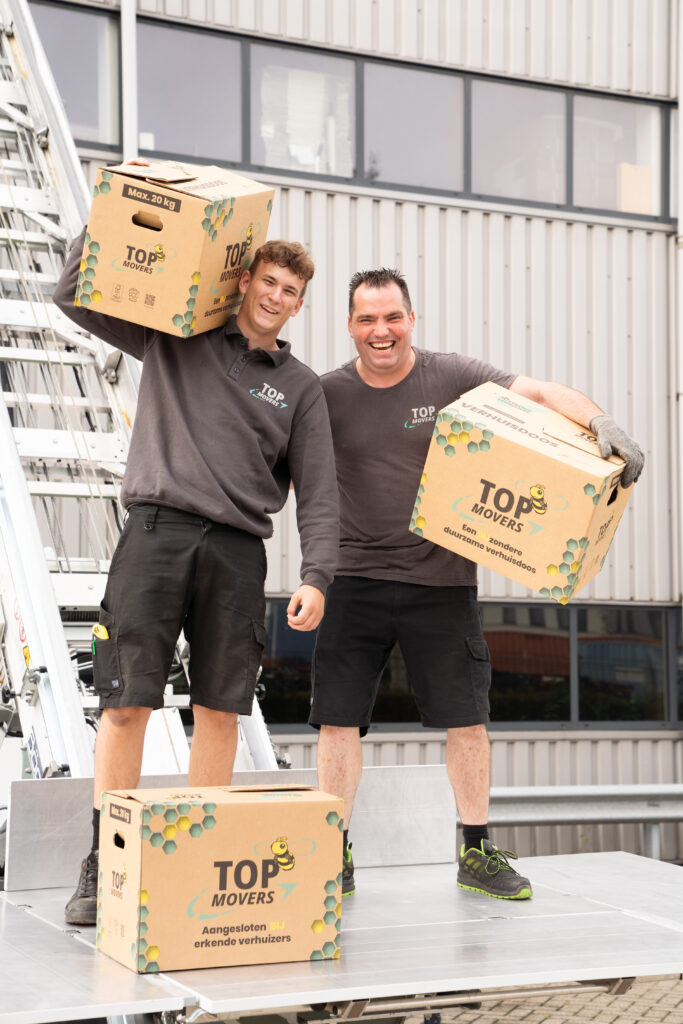
To connect a moving company to your CSRD reporting, your moving partner must be able to provide concrete emissions data, waste streams, and circularity information that fits within your sustainability reporting. This applies to every organisation that falls under the CSRD obligation and is planning a business relocation. In this article, we answer the most frequently asked questions about sustainability data, contractual agreements, and evaluating moving partners in the context of the CSRD.
Which moving activities fall within your CSRD scope?
Moving activities generally fall under Scope 3 of your CO2 reporting, the category of indirect emissions in the supply chain. Specifically, this concerns transport emissions from moving vehicles, the energy consumption of temporary storage, the processing of discarded office furniture, and the use of packaging materials. All of these activities count when you want to compile a complete and reliable CSRD report.
Many facility managers underestimate how broad the scope of an office relocation actually is. A move involves more than just driving from A to B. Think about the procurement and processing of packaging materials, the storage of inventory at an external storage location, and the disposal or repurposing of furniture that is not being taken to the new location. All of these sub-activities generate emissions or waste streams that are relevant to your sustainability report.
Specifically for organisations in the petrochemical industry or the Port of Rotterdam, where sustainability ambitions are increasingly part of corporate strategy, it is important to also include the indirect impact of facility activities such as relocations. After all, the CSRD requires you to provide a complete picture of your environmental impact, including activities that you outsource to third parties.
What data must a moving company provide for your sustainability report?
For a CSRD-compliant sustainability report, a moving company must at minimum be able to provide the following data: the CO2 emissions from transport, expressed in kilograms of CO2 equivalent, the weight and processing method of packaging materials used, information about the fate of discarded furniture (reuse, recycling, or waste), and the energy consumption of any storage facilities.
The more specific the data, the stronger your report will be. A moving company that simply says “we drive electric” provides insufficient substantiation for your sustainability report. You need numbers: how many kilometres were driven, with what type of vehicle, and what is the corresponding emission factor? The same logic applies to packaging materials. Are the moving boxes made from recycled material? Are they reused or recycled afterwards?
A moving partner that works with a furniture passport, as we do through Circular Connect, can also make visible which furniture gets a second life and which raw materials are recovered. This type of data not only strengthens your CSRD report, but also supports your broader circularity objectives.
How do you assess whether a moving company is CSRD-ready?
A moving company is CSRD-ready if it holds relevant environmental certifications, has demonstrable processes for measuring emissions and waste streams, and is willing to share this data with you at project level. During the selection process, always ask about ISO 14001 certification, the CO2 Performance Ladder, and concrete examples of previously delivered sustainability reports.
In addition to certifications, there are a number of practical questions you can ask during the selection process:
- Does the moving company have electric or low-emission transport available?
- Can they provide a CO2 report per project?
- Do they work with reusable packaging materials and can they demonstrate this?
- Do they have a demonstrable policy for the repurposing of office furniture?
- Are they willing to make contractual agreements about sustainability data?
A moving company without answers to these questions is simply not suitable as a partner for organisations that are serious about CSRD compliance. We work as a business moving partner with ISO 14001, ISO 9001, and the CO2 Performance Ladder, and can provide concrete emissions data per move that can be used directly in your sustainability report.
What are the risks of a moving company without sustainability data?
If you engage a moving company that cannot provide sustainability data, you risk having a portion of your Scope 3 emissions undocumented in your CSRD report. This leads to an incomplete sustainability report, which can cause problems during external verification or stakeholder scrutiny and undermines your credibility as a sustainable organisation.
The risks are concrete and multiple. First, there is the compliance risk: an incomplete report can lead to questions from auditors, regulators, or shareholders. Second, there is the reputational risk: if it turns out that your sustainability claims are not fully substantiated, this damages the trust of customers, partners, and employees.
In addition, there is a strategic risk. Organisations that do not gain control over their Scope 3 emissions now will fall behind competitors who do. The CSRD obligation will only become stricter and more broadly applicable in the coming years. Those who now invest in a moving partner that provides sustainability data are building a stronger foundation for future reports.
Finally, there is the operational risk of furniture without documentation. Furniture that is disposed of without a passport or repurposing plan disappears into the waste chain without you knowing whether it was recycled, reused, or landfilled. This makes it impossible to substantiate circularity claims.
How do you contractually record agreements about sustainability data?
You contractually record agreements about sustainability data by including specific obligations in the assignment agreement or the Service Level Agreement about which data the moving company will provide, in what format, within what timeframe, and at what level of detail. Vague intentions are not sufficient; you need concrete, measurable agreements that are externally verifiable.
Include at minimum the following elements in your contractual agreements:
- Specification of the data to be delivered: Explicitly state which data you expect, such as CO2 emissions per transport kilometre, weight and type of packaging material, and waste processing reports.
- Format and standard: Agree on the format in which the data will be provided, preferably aligned with the standard used by your accountant or sustainability advisor.
- Timeframe: Set a hard deadline for delivery, preferably within two weeks of completion of the move.
- Verification possibility: Record that the data is verifiable and that the moving company can provide underlying documentation upon request.
- Penalty clause: Consider including a provision that describes what happens if the data is not delivered or is delivered incompletely.
For organisations that relocate regularly, for example due to growth, reorganisation, or rehousing, it is advisable to include these agreements in a framework contract. This way, you do not have to renegotiate with every move and you can be sure that sustainability data is always part of the service. A reliable moving partner will accept these agreements without objection, because they already have the processes and systems in place to deliver this data on a structural basis.
Veelgestelde vragen
Geldt de CSRD-verplichting ook voor kleinere kantoorverhuizingen, of alleen voor grootschalige relocaties?
De CSRD-verplichting maakt geen onderscheid op basis van de omvang van een verhuizing. Als jouw organisatie onder de CSRD valt, moet je alle relevante Scope 3-emissies rapporteren, ook die van een relatief kleine kantoorverhuizing. Zelfs een verhuizing van een klein team kan transportemissies, verpakkingsafval en meubelafvoer genereren die meetellen in je duurzaamheidsverslag. Het is daarom verstandig om voor elke zakelijke verhuizing, groot of klein, dezelfde datavereisten te hanteren.
Wat als mijn verhuisbedrijf wel duurzaam werkt, maar geen officiële certificeringen heeft?
Certificeringen zoals ISO 14001 en de CO2-prestatieladder zijn geen wettelijke vereiste, maar ze bieden wel de sterkste externe onderbouwing voor je rapportage. Als een verhuisbedrijf geen certificeringen heeft, kun je vragen om alternatieve bewijsstukken, zoals brandstofregistraties, weegbonnen van afvalverwerkers of verklaringen van recyclingpartners. Houd er echter rekening mee dat niet-gecertificeerde data moeilijker te verifiëren is door je accountant of duurzaamheidsadviseur, wat het risico op een onvolledige of betwistbare rapportage vergroot.
Hoe integreer ik de duurzaamheidsdata van mijn verhuisbedrijf in mijn bestaande CSRD-rapportageproces?
Vraag je verhuispartner om de data aan te leveren in een format dat aansluit op de standaard die je duurzaamheidsadviseur of accountant hanteert, zoals GHG Protocol-categorieën of een specifieke spreadsheetstructuur. Zorg dat de data tijdig beschikbaar is, bij voorkeur binnen twee weken na de verhuizing, zodat je deze kunt verwerken in je reguliere rapportagecyclus. Als je werkt met een duurzaamheidsplatform of ESG-software, vraag dan of je verhuispartner de gegevens in een compatibel exportformat kan aanleveren.
Kan ik mijn verhuisbedrijf ook verantwoordelijk stellen voor de circulariteit van afgedankt meubilair?
Ja, en dit is zelfs sterk aan te raden. Leg contractueel vast dat de verhuispartner verantwoordelijk is voor het documenteren van de herbestemming van elk meubilstuk dat niet meegaat naar de nieuwe locatie, inclusief of het wordt hergebruikt, gerecycled of afgevoerd als restafval. Een verhuispartner die werkt met een meubelpaspoort of een circulaire verwerkingspartner kan je hierin ondersteunen. Zo kun je in je CSRD-rapportage aantoonbaar maken welk percentage van je meubilair een tweede leven heeft gekregen, wat bijdraagt aan je circulariteitsdoelstellingen.
Wat is een realistisch tijdspad om een verhuisbedrijf CSRD-conform te selecteren en contracteren?
Reken op minimaal vier tot zes weken voor een zorgvuldig selectie- en contracteringsproces. In de eerste twee weken inventariseer je welke duurzaamheidseisen jouw organisatie stelt en vraag je offertes op bij meerdere verhuispartners, inclusief expliciete vragen over hun datamogelijkheden en certificeringen. In de daaropvolgende weken beoordeel je de antwoorden, vraag je om referenties of voorbeeldrapportages en stel je het contract op met de benodigde duurzaamheidsclausules. Begin dit proces ruim voor de geplande verhuisdatum, zodat je niet onder tijdsdruk genoegen hoeft te nemen met een partner die niet volledig CSRD-klaar is.
Mijn organisatie verhuist regelmatig vanwege groei. Hoe voorkom ik dat ik dit proces elke keer opnieuw moet doorlopen?
Sluit een raamcontract met een vaste verhuispartner die al voldoet aan je duurzaamheidseisen. In dit raamcontract leg je eenmalig alle afspraken vast over de te leveren data, het format, de termijnen en de verificatiemogelijkheden, zodat deze automatisch van toepassing zijn op elke volgende verhuizing. Dit bespaart tijd, voorkomt heronderhandeling en garandeert consistentie in de kwaliteit van je duurzaamheidsdata over meerdere rapportagejaren. Evalueer het raamcontract jaarlijks om te controleren of de afspraken nog aansluiten op de actuele CSRD-vereisten.
Hoe ga ik om met een verhuizing waarbij meerdere leveranciers betrokken zijn, zoals een apart transportbedrijf, een opslagpartij en een meubelleverancier?
Bij een verhuizing met meerdere leveranciers is het essentieel dat je voor elke partij afzonderlijk duurzaamheidsdata opvraagt en contractueel vastlegt. Wijs één partij aan als coördinator die verantwoordelijk is voor het samenvoegen van de data tot één overzichtelijk projectrapport. Zorg dat alle leveranciers dezelfde rapportagestandaard hanteren, zodat de data onderling vergelijkbaar en optelbaar is. Als dit te complex wordt, is het werken met één geïntegreerde verhuispartner die alle deelactiviteiten in eigen beheer of via vaste onderaannemers uitvoert, de meest efficiënte oplossing voor een sluitende CSRD-rapportage.
Gerelateerde artikelen
- Wat zijn de voordelen van een gefaseerde bedrijfsverhuizing?
- Phased relocation vs. one-shot relocation: what suits your business?
- How do you manage ongoing projects during a business relocation?
- How to make a business relocation more sustainable?
- What is a realistic budget for an office relocation of 50+ employees?
- How do you transport your car when moving back from Spain to the Netherlands?
- Hoe bereid je een bedrijfsverhuizing goed voor?
- Hoe zorg je voor minimale downtime bij een kantoorverhuizing?
- Hoe ga je om met personeel dat niet mee wil verhuizen?
- Wat is de rol van HR bij een bedrijfsverhuizing?
- Wat moet je regelen voor de parkeerruimte bij een nieuw bedrijfspand?
- Wat kost tijdelijke meubelopslag voor bedrijven en wanneer loont het?
- Heb je een NIE-nummer nodig om in Spanje te wonen?
- Waar wonen de meeste Nederlanders in Spanje?
- Wat moet je regelen als je terugverhuist naar Nederland?